How to change careers in your 40s and 50s

Photo by krakenimages on Unsplash
You’ve arrived at midlife. And even if you’re not sensing or sighting any sign of that classic midlife ‘C’ word, two other big ones are very much on your mind - career and change.
Maybe you’ve outgrown a career you once loved. The things it’s given you in spades- a sizeable income, status, authority, and influence aren’t so important any more. Now you’re wondering about the difference you’ve actually made and the legacy you’ll leave.
Perhaps you’ve achieved a lot in your career but sacrificed a lot en route to that success: autonomy, creativity, flexibility, family time, and fun. You’re wondering if you can reclaim some of those things.
Maybe this is the moment to revisit that cherished, slightly crazy career ambition you put quietly aside to pursue something more ‘sensible and solid’? You’re still keen and dead curious to give it a go.
A midlife career change feels definitely on the cards. Maybe it’s even made it onto your ‘to do’ list. But you have so many unanswered questions.
Read on.
Is it too late to change careers in your 40s or 50s?
No. Firstly, the right age to change careers is the one you’re at when you know that something’s got to give. And while your career change path will look different at 42 or 55 than it might have at 22 or 35, it’s perfectly possible to transition to something new once you hit 40.
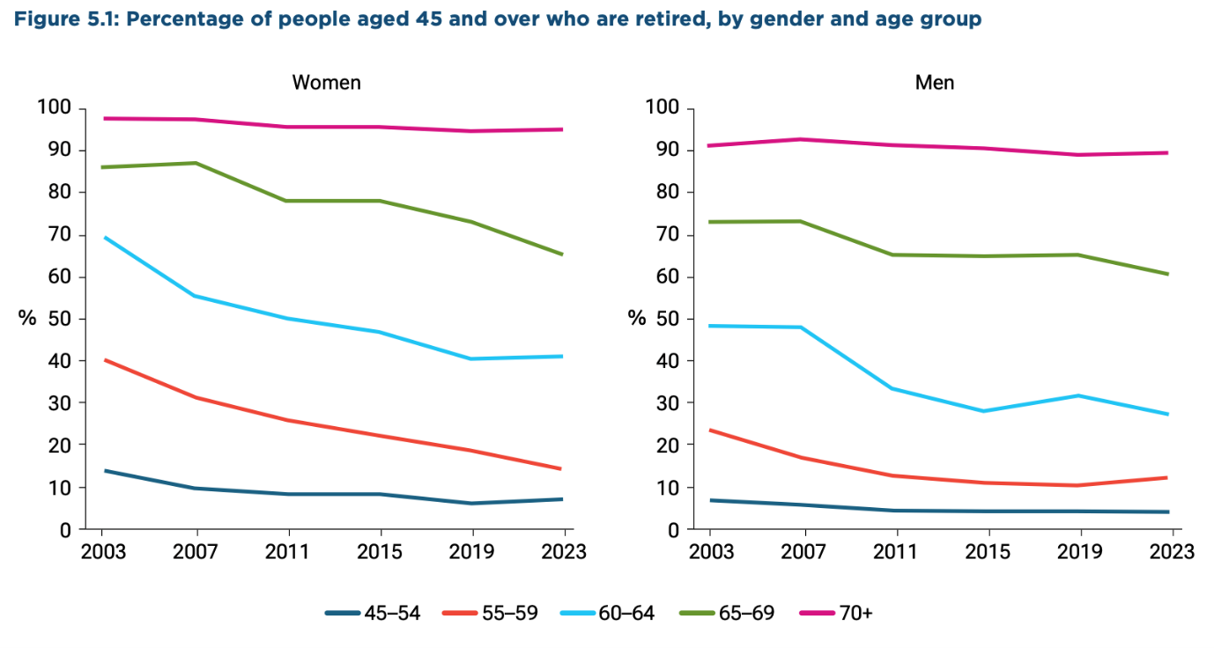
In fact, there’s a good chance the force will be with you (more on that in a minute). Secondly, the stats (as well as the force) are on your side. Australians (like pretty much everyone else) are working longer. The HILDA (Household, Income and Labour Dynamics in Australia) Survey found that 1 in 3 Australians in their late 60s is still working. And over the past 20 years, retirement rates for women aged 60–64 have fallen from 70% to 41%, and for men from nearly 50% to just 27%.
So, if you’re considering a midlife career change, you’ve got between 10 and 20 years to build that satisfying new career. Or on the other hand, that’s a helluva long time to stay stuck in a career you no longer love.
Is it too hard or too risky to make a midlife career change?
Deciding to change careers at any age means moving to the edge of your comfort zone and enrolling in a masterclass in managing uncertainty.
And when it comes to taking calculated risks and dealing with discomfort, age is an asset. You’ve had oodles of practice keeping calm under pressure and sizing up and making tough, tricky decisions.
Frankly, in your 40s and 50s, age is an all-around asset for career change. You have decades of diverse experience and well-honed, real-world skills. You’re an emotionally and socially mature grown-up with sound instincts and solid judgement. You know how to persuade, reassure and lead others.
Many businesses and organisations are looking for clued-up, critical thinkers with cool heads who weren’t born yesterday. And in more good news, this is especially so in fields where AI can change tasks but can’t come close to replacing human ingenuity, dexterity and social and emotional intelligence. In fact, in a warp-speed world of tech-driven change, midlife wisdom, perspective and sangfroid matter more than ever.
OK, now we’ve established that a midlife career change is doable and most likely destined to succeed in spades. Let’s get into the nitty-gritty.
6 Tips for changing careers in your 40s and 50s
1. Get clear on what’s driving you to change
You’re likely motivated by some of the things that drive career change at any age. Maybe your values and lifestyle have shifted, and you’ve outgrown your role or sector. Maybe you want more flexible hours, more control and autonomy or more creative freedom.
Perhaps you’re driven by a mix of the classic things, plus a more age-specific urge to seek and measure meaning beyond personal success.
Writer and researcher Brené Brown calls these ‘internal rumblings about meaning and purpose’ your Midlife Unravelling. In her typically no-BS style, she describes this as the moment when the universe taps you gently and says, ‘You are halfway to death, get a move on’.
Maybe you’re facing the ‘legacy’ question
Psychologist Erik Erikson theorised that, between 40 and 65, humans experience ‘the battle between generativity and stagnation’.
Generativity is a psych jargon for the desire to leave a legacy — not a material one, but one that answers the question, ‘What am I giving to others and to the future?’ Generativity triggers the need to pass on what you know and nurture the next generation.
Stagnation often shows up around the same time. It's a suffocating sense that you're just stuck, spinning your wheels, ensuring nothing but your own survival.
Working out your unique mix of classic and midlife motivators helps set some boundaries and clear the decks for the next stage.

Image by Vladimir Srajber on Pexels
2. Refine what you do and don’t want
One advantage of a midlife career change is that your grasp of what you do and don't want is probably stronger than it was a decade ago. By now, life has shown you your strengths. You’ll most likely have a reliable sense of what attracts and repels you.
That said, one of the most challenging and rewarding aspects of career change is staying curious and open to intriguing, out-of-the-blue possibilities you might not normally have considered or even knew existed.
So armed with what your 40+ self knows about what will and won’t work for you, a flexibly minded sense of adventure, and support from a single trusted human (or a squad of onside cheerleaders), start figuring and fleshing out a plan for discovering your best fit mid-life career.
Start with what you want, not what you think you can get. Give yourself permission to want what you want first, then work backwards to figure out the path.
Start working backwards by:
Detailing your career must-haves, love-to-haves, and wouldn’t-touch-with-a-10-foot-barge poles.
Auditing your well-oiled, wildly transferable skills. Tease out ‘second nature’ ones, ones you love to use, rarely used ones you’d like to make more of, ones you’re done with using.
List the roles, fields, and formats (hybrid, freelance, portfolio, part-time) you’re interested in exploring. Add at least one mad option.
At this point, it may be useful to enlist AI (if you haven’t already). See AI and career change - how to generate ideas and find contacts.
Use your carefully crafted mix of human and robot-generated intel to create a short (or long) list of real-world career options to explore. Unless you’re already dead set on the shape you want your career change to take, be open to two things:
Taking a sideways step or tweaking your current career
Exploring the range of highly sought-after midlife options like freelancing, consulting and portfolio careers.
3. Bust some pesky, persistent career change myths
Before you head out to test what’s desirable and doable (in that order), clear out some of the mental clutter that comes with unchallenged career change assumptions. Put a few persistent career-change myths to rest. Start with these.
The ‘I’ll end up bankrupt and broken’ myth
Two of the scariest questions that cause career changers to wake in fright are these.
How can I stay afloat financially while I change careers?
Will I lose everything (money, time, education, reputation) I’ve invested in building my career?
Get to grips with the first one by eyeballing the money monster, assessing your resources and planning for what’s possible. One midlife advantage you may have is that while you might have hefty financial commitments, you may have fewer unknowns.
Plus, you’ve sharpened your money smarts by surviving your (often freewheeling but frequently skint) 20s and your (managing money like a grownup) 30s.
4 Ways to fund your career change.
The second question has its roots firmly fixed in the sunk cost fallacy. This is our very human tendency to stick with something we’ve invested all kinds of resources in, even in the face of compelling evidence that sticking is not our best option.
Side-step the sunk fallacy trap by accepting that nothing you do is ever lost or wasted. In career change terms, the mighty investments you’ve made by the time you’ve hit 40 will serve you well in the next one.
The ‘I’ll have to start from scratch’ myth
You won’t — end of. First up, there is no ‘scratch’. You are a hugely experienced human with a swag of transferable skills that you can adapt and build on in your new career. Secondly, few midlife career changes start at ground zero. Most people pivot, bridge, tweak, or sidestep.
On the other hand, if you do fall hard for something totally different from what you’ve done to date, go for it because … No experience needn’t lock you out of a new career.
The ‘best jobs never get advertised’ myth
The idea that there is a hidden job market, flush with fabulous roles only available to those ‘in the know,’ is a relic of pre-Internet job searching.
That said, the reality is that many jobs, including senior roles and freelance opportunities that are attractive to midlife career changers, are filled in-house or through networking. In your 40s and 50s, you’re ideally placed to tap your deep networks for intel on intriguing work options.
For tips on using AI to tap into your LinkedIn network, read Michael Brown’s Post.
And for the around 40% of roles that do get advertised on the Internet, you're ideally placed to show how experience makes the difference.
Want tips on using AI to edit your human-generated CV? AI and career change — Refine your CV, rehearse your interview.
Still wondering about that hidden job market and how it might affect your career change chances? Read 80% Nonsense. Busting the hidden job market.
4. Engage and explore

By Mike Jones on Pexels
Up until now, maybe your career change plan has been pretty much a secret shared with Google, your best AI buddy, and one or two trusted supporters. Now is the moment to engage with lots more humans
Having laid some solid (and often quite solitary) groundwork. It’s time to test some intriguing possibilities in the real world. A great first step here is to start by looking for people, not jobs.
Humans doing the work you’re keen to explore are a priceless source of intel. Find them through your flesh-and-blood and digital networks. Front them gently but openly at conferences, workshops and community events. And have career conversations.
If you’re wondering and worried about whether people will be willing to give you time and attention. Ask yourself if you’d happily spare half an hour to help a curious career changer understand the good, great, and gruesome realities of your job. Of course you would. Most humans are hardwired to help if they can.
How to have confident career change conversations.
5. Make space to explore
There are loads of ways to create opportunities and headspace to explore new career options without upending your often delicately balanced world. Here are three of them
1. Reduce or change your current hours at work
How to ask for different hours at work
2. Do pilot projects
Find low-risk but high-value ways to test your skills and try out new sectors. Volunteer for community groups or projects. Pick one or two of your in-demand skills (you’ll have a few) and offer workshops to groups looking to skill up in those areas. Look for paid or unpaid advisory roles.
Tap your networks for work shadowing opportunities. Start a creative side gig making and marketing something delicious, useful, or fun.
Testing your hunches and assumptions about what’s right for you is a crucial step towards making a confident career change.
3. Find a bridge job
A bridge job is a less demanding and probably less lucrative stopgap that pays the bills and buys you time and brain space to figure out what you really want to do next. It could be part-time consulting in your current field, or something totally left field that’s easy (and maybe even fun) to do.
If you can’t stomach your current work a second longer but you’re not ready or able to take a complete break, a bridge job can give you time to breathe, reenergise, explore and retrain. Taking a bridge job can also build your confidence that you can create change safely.
6. Take your time
Because you have it — anywhere from 10 to 20 years. Because you’re most likely juggling midlife’s set of complex commitments. Because however tempted you may be to cut and run from a career you’ve outgrown, you’re (dare I say it) old enough to believe in planning, patience and persistence for the win.
Try some of these small, smart moves.
My last career change took 2 years of combining part-time contract work with training while I learned about, launched and built my career coaching business. Was it frustrating or tricky to ‘wait’ two years? It was not. I planned a staged transition that fitted with my family and financial responsibilities and matched my thorough, orderly way of doing things.
Contemplating a midlife career change? Book a chat.
Hi, I’m Jo Green, a Career Change Coach.
I help thoughtful professionals who feel stuck or unfulfilled in their work find a clearer direction and move into work that feels meaningful and aligned with who they are.
Since 2016 I’ve supported hundreds of people to reshape their careers – whether that means changing roles, starting something new, or finding work that contributes more positively to people or the planet.
If you're thinking about a career change and want structured support, you can learn more about my career change coaching here. Or you’re welcome to book a free 20-minute consultation to talk about where you’re at and whether coaching could help.
Not sure it's time for coaching yet?
I can send you three questions to ask yourself before you change careers — so you leap towards the right thing, not just away from the wrong one. Free, and it takes about one quiet coffee to work through. Sign up here to get the free guide (and I'll send occasional career tips in my newsletter).