AI and career change — Refine your CV, rehearse your interview

Source - Software Finder Study
If you’re asking AI to help you magic up a standout CV, craft a captivating cover letter, or prepare for a winning interview, you’re in good company.
Research by Software Finder indicates that 75% of job seekers use AI to prepare and polish their job applications (and the graph here shows at what stages).
Prompt AI precisely and prescriptively (be super clear about what you don’t want), and its giant robot brain will do a decent job of crunching the data you feed it. It can do a useful ‘first pass’ assessment of how well your skills stack up against the requirements for a given job. It can help identify gaps and point you at priority skills and keywords to highlight in your application.
Want tips for prompting AI with purpose and authority? Here you go.
Want tips for using AI wisely and well to craft standout job applications? Read on.
1. Spruce up your CV — 2 Time-and-brain-space saving things AI can do
Interrogate the job description
Upload the job description and job advert and ask AI to identify the 10 – 15 most important skills and keywords.
Reality-check your current (de-identified) CV against these skills
Remove all identifying information like your name, email, phone number, and address from your CV. Then upload it to AI.
Ask it to identify:
Skills gaps for this job
Skills you have that match, which you could make more of and link more closely to the job requirements
NOTE: When the employer’s AI reviews your CV (and about a bazillion others) during the application process, it looks for evidence of skill depth. Ask AI which key skills you can repeat and illustrate to show this.
2. The thing you shouldn’t ask AI to do (as tempting as it is)…
…the actual writing, including making stuff up to fill in the gaps.
Source - Software Finder Study
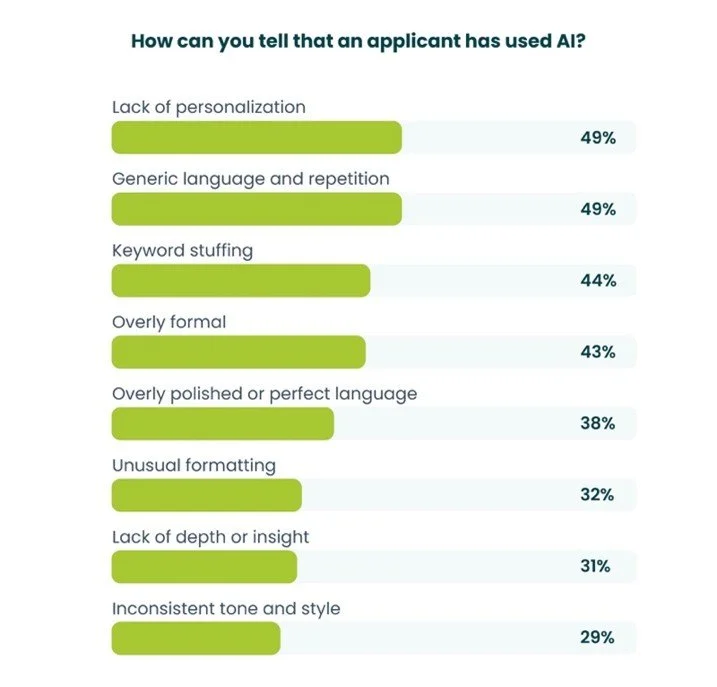
You’re bound to get tripped up at an interview when asked about ‘fibs’ AI has told them about you. And your robot-generated CV will undoubtedly commit some of the ‘unoriginal sins’ that hiring managers are well and truly onto.
Just to put those ‘sins’ in perspective, 60 per cent of hiring managers surveyed by Software Finder outlined the ways they could tell an AI-generated CV from one crafted by a flesh-and-blood human.
Enough said! Once you’ve used AI to pick apart the job description and take a steely, robotic look at your skills gaps and strengths, it's time to take back control of your story.
Your words, your voice, your personality
Use your AI intell on skills, strengths, and gaps to rewrite sections that need more detail. Review the unoriginal sins above. Be super vigilant about being overly generic, overly formal, or overly polished. Be consistently and confidently … you. Read the sections aloud. Do you sound like a capable, interesting, warm-blooded human sharing insight about and enthusiasm for the role?
Once you’re done, ask AI to review your freshly focused, fabulously targeted, and original CV against what it knows about the job in question.
If you’re tempted to hand the whole resume kit and caboodle over to AI, put yourself in the shoes of an exasperated hiring manager I know, who got 5 identical, AI-generated CVs for a role! Do not risk owning one of those CVs!
Or heed these words from the owner of sustainable stationery producers, Martha Brook, who had zero trouble spotting (and mostly rejecting) AI-generated slop in the 2000-plus applications she received for a single role in a single week.
‘Aside from the obvious copy-and-paste jobs from ChatGPT, many applications regurgitated the job description and sounded generic. In a pool of thousands, I’m looking for candidates who sound human, showcase their unique voice and show they’ve done their research rather than relying on AI to do the heavy lifting.’
Find this quote and a bunch of other useful insights in this article in the Guardian newspaper - ‘How to use AI to get a job interview and nail it – along with the salary you deserve.’
2. Preparing for interviews
If you’ve already used AI to organise your CV for a specific job application, it’ll have everything it needs to help you prepare for an interview. If you’re starting afresh, upload the new job description.
Framing the questions
Ask AI for 10 interview questions specific to that role and 10 general interview questions you might get asked.
Then, remember that an interview should never be a one-way conversation all about proving you’re a great fit for the position; it’s also your chance to check that the role is what you think it is and if it’s likely to suit you.
So, ask AI your version of ‘What questions should I ask about [the role] in [the company], given that flexible hours/ supportive leadership/progression/ cohesive team/ autonomy, etc., are important to me?’
Practising your responses
Practising out loud with a discerning human who will give you honest, supportive, and critical feedback is best. But you can also activate the voice mode of your chosen AI tool. Ask it to conduct a mock interview and give you feedback on your delivery and the substance of your answers. This AI tool may also give you some tips.
Streamlining your application process
Doing some big picture planning around how to craft consistently wow-worthy applications that make you stand out from the crowd? This AI prompt from Forbes’s Caroline Castrillon may be worth a look - ‘Craft A Standout Application Strategy’.
Playing to AI’s strengths
The applications phase of a career change can feel like a cross between playing an adrenaline-pumping blood sport and working on a brain-numbing production line. AI’s gift for crunching data can hugely reduce the brain-numbing preparatory bit by compiling and comparing skills info at warp speed. But when it comes to the performative, blood sport bits, aka delivering a lively, personality-packed CV and a stellar interview, for that you’ll need #teamhuman – that’d be you and your career change cheerleaders.
Make the most of Ai’s capabilities by:
Prompting it with clarity and precision, including telling it what you don’t want it to give you
Checking the accuracy, currency and completeness of what it gives you, cos... who knew?... AI is prone to hallucinations
Doing due human diligence to edit AI’s typically soulless text to sound like you — a lively, curious, clever, one-of-a-kind career changer
Remembering these prescient words from physicist and Nobel Laureate Richard Feynman (who died in 1988): ‘AI can beat me at chess, but not at poker.’
Need 100% human help to play your career change cards right? Book a chat.
Hi, I’m Jo Green, a Career Change Coach.
I help thoughtful professionals who feel stuck or unfulfilled in their work find a clearer direction and move into work that feels meaningful and aligned with who they are.
Since 2016 I’ve supported hundreds of people to reshape their careers – whether that means changing roles, starting something new, or finding work that contributes more positively to people or the planet.
If you're thinking about a career change and want structured support, you can learn more about my career change coaching here.
Or you’re welcome to book a free 20-minute consultation to talk about where you’re at and whether coaching could help.