
How to change careers after 60

By Vlada Karpovich on Pezels
Some of the most fulfilled people I know made their most courageous career moves in their 60s — not despite their age, but because of it.
These career changers were ready to do the work that really mattered to them. They had the confidence and self-awareness not to care what other people thought or said about their career or lifestyle choices.
They also had the huge career-change assets that come with decades of experience. They’d survived seismic tech shifts, honed their social and emotional intelligence by piloting teams through good times and bad. They’d managed minuscule, middling and massive projects with care and aplomb. They’d built deep networks most 30-year-olds can only dream of.
For these people and many others like them (stats to follow), hitting 60 wasn’t the end of their career adventure; it was where the most interesting chapter began.
Are more Australians staying in work in their 60s?
In case you’re wondering if not retiring and changing or reshaping your career in your 60s is rare (or weird), it’s not.
Australian Bureau of Statistics (ABS) data shows that the rate of workforce participation over 65 has nearly tripled between 2001 (6%) and 2021 (15%).
And a 2023 OECD report put the employment rate for Australians aged 60‑64 at 59.5%, above the OECD average of 55.9%. The report also noted a 26.9% increase in this rate between 2000 and 2024.
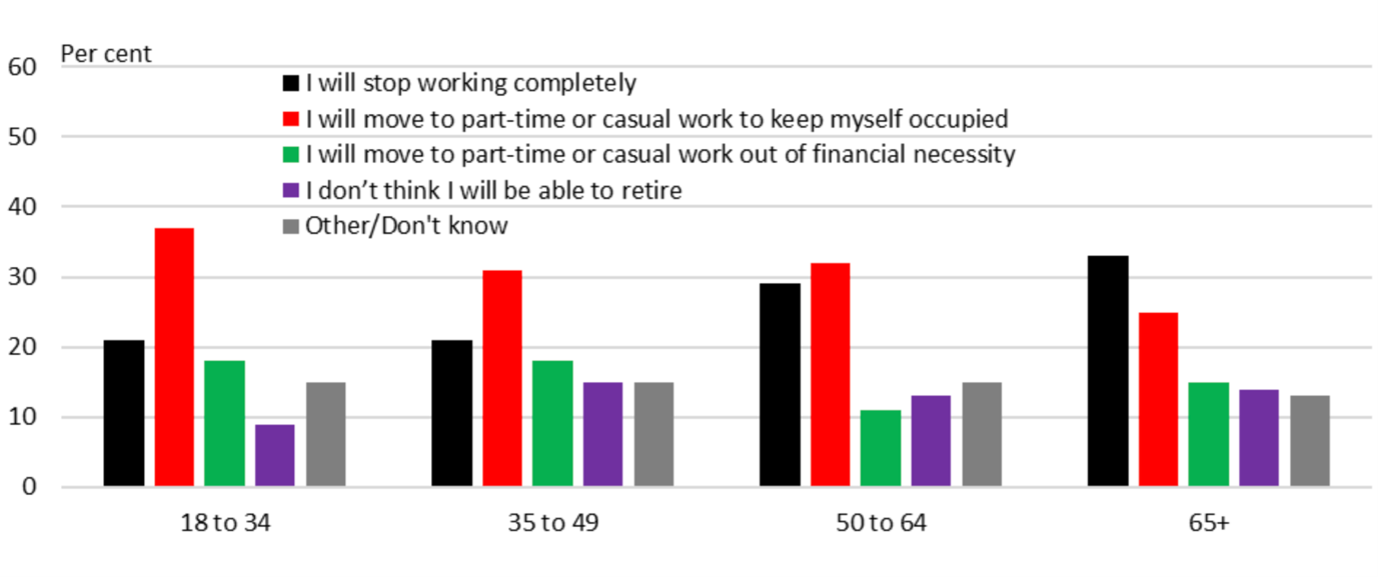
Intentions to retire amongst working Australians aged 18-65+. Source: ASFA research reveals retirees intend to stay flexible, many eye part-time work
And while there is no doubt that many 60+ Australians are working for financial reasons, research by ASFA, the peak research and advocacy body for Australia’s superannuation industry, found that 25% of people still working at aged 65+ planned to continue some form of work for the social connection and stimulation.
Twenty years ago, 1 in 10 men were still working at 70. Today it's 1 in 4, including my father-in-law, who is 81 and still works part-time, not because he has to, but because he enjoys it and knows it keeps his mind sharp.
Finally, here’s a stat to smile at and file for the next time someone tries to tell you you’re too late or too old to change careers. We may peak physically in our 20s and 30s, but recent joint Australian and Polish neurological research shows our overall mental functioning peaks between 55 and 65. In more good news, conscientiousness peaks around 65, and our capacity to sidestep the kinds of mental short-circuiting that weakens good decision-making may continue to get stronger into our 70s and 80s.
What does it take to change careers in your 60s?
Believe that it’s possible. A strong sense of self-belief helps you muster the confidence and tenacity to change careers at any age. And while you’re likely to have developed solid self-belief by your 60s, it can take a hit when you decide to change careers.
Why? Mostly because your brain will get busy doing what brains do: looking for evidence to confirm what your inner doom-mongering critic and (possibly a few flesh-and-blood ones as well) tell you, which is, ‘Nobody changes careers in their 60s’.
And if you don't know anyone who has made a significant career change at your age, it can be very hard to believe it's doable. Not because it isn't — it absolutely is — but because our brains are pattern-matching machines.
No pattern, no belief. No belief, no action.
So, here's what to do about that: go and find the evidence your brain is missing.
Seek out people who have changed careers in their 50s and 60s. They're out there — more of them than you'd think. Ask them about their experience. What made them finally take the leap? How did they navigate the practical challenges? Did they encounter ageism, and if so, how did they handle it? What do they know now that they wish they'd known at the start?
How to have confident career change conversations.
You’ll gather a heap of inspiring and practical intel and connect with like-minded people. You'll also rewire what you believe is possible. And that shift from ‘I don't think this can happen for me’ to ‘I've met people who made it happen’ is often the single most important first step you can take.
If you’ve had those sparky conversations but still feel a career change is possible for others but not for you, here are 4 ways to sharpen your self-belief and shift those doubts.
Do you really believe you can change careers?
Rediscover your spark
Something my 60+ clients often tell me is that work has become a grind.
Their motivation that once burned brightly or even just ticked along reliably has flatlined. And for some people, that flatness has seeped into the rest of life. When we look back, it’s not hard to see why this has happened for them, and perhaps it rings true for you too.
Maybe you’ve spent decades in the same career or company, gradually narrowing your focus to fit what was required of you. Perhaps you poured your energy into raising children or caring for ageing parents — vital, meaningful work, but work that can leave you feeling like you've lost track of yourself somewhere along the way. You look up one day and realise you're not sure what you enjoy anymore. What excites you. What you'd choose to do if choosing felt like an option. Feeling this sense of loss is more common than you might think.
Help to re-find your fun

By Roberto Rosi on Pexels
A few sessions into her career change coaching, one of my recent 60+ clients had a realisation that stopped her in her tracks: she had lost more than her career direction. She had lost her fun. The life-affirming parts of herself that had nothing to do with responsibility or obligation had gone AWOL — curiosity, lightness and her sense of play.
A big part of the work we did next was around helping my client tune back in to what genuinely draws her — what lights her up, what gives her energy. We worked on answering the question: What does she gravitate toward when nobody's telling her what to do?
Not everything we discovered translated directly into a career idea, and that's perfectly fine. But we uncovered something more essential: a clearer picture of what needs to be in her life from now on, whether that shows up in work, outside of it, or both.
Because sometimes a career change in your 60s isn't really about the career at all. It's about reclaiming the parts of yourself that got quietly set aside while responsible, adult life was happening.
Approaching your career change with a light touch and sense of fun is a great way to start reclaiming those parts that went AWOL.
5 Seriously good ways to be a playful career changer.
Reassess and redirect
Start with what you want, not what you think you can get. Too many career changers of all ages self-select out of possibilities before they've even explored them properly.
In short, give yourself permission to want what you want first, then work backwards to figure out how to get there.
What matters most? Keeping earning, staying engaged and contributing to community, doing that cherished thing you’ve had on hold for [insert number of years you’ve waited]. Maybe it's all of the above … that’s fine.
Write down everything you're good at — not just your job titles, but the actual skills and strengths underneath them. Leadership, communication, problem-solving, relationship-building, strategic thinking, deep subject matter expertise. These don't expire.
Think about what you want your working life to look like from here. There are loads of options — full-time, part-time, freelance, portfolio. Make a pact with yourself to explore the options before you choose. Talk to people, tap your networks and look for opportunities to test them out through side gigs and volunteering.
Take your time and take small steps.
Most successful career shifts happen slowly. High drama and giant leaps are rare. Many 60+ career changers find the variety, flexibility and meaning they're looking for in a portfolio of work combining part-time roles, consulting, board positions, volunteer work, and passion projects. They get to use their well-honed skills in new contexts, train in and practice new ones and best of all, rediscover their fun.
2 Timeless tips for dealing with ageism
Ageism is out there. Pretending otherwise wouldn't be doing you any favours.
Ironically, lurking behind the unconscious (or even conscious) bias some industries and companies have against older workers is a preference for employing people with the attributes 60+ humans have in spades: reliability, emotional maturity, experience and grace under pressure.
According to the 2025 Australian Human Rights Commission and Australian HR Institute report, older workers rated significantly higher than their younger counterparts for all these sought-after qualities.
Ageism, it seems, says nothing about the professional capabilities of 60+ people and everything about the mindset of hiring managers.
And if you're considering self-employment, consulting, or building a practice of your own, ageism in the traditional job market becomes largely irrelevant.
Filtering for ageism
An organisation with an ageist culture is probably not somewhere you'd want to spend the next chapter of your working life. Use your career conversations and research as a filter for weeding them out.
As you explore career ideas and talk to people in different fields, ask about the culture and keep your antennae tuned for any hint of ageist bias or behaviour. Find the organisations and industries that would be genuinely delighted to have someone with your depth of experience.
Because they absolutely exist, often (but not exclusively) in sectors like consulting, coaching, education, healthcare, social services, governance, and not-for-profit, which actively seek out people with sufficient life experience to bring grounded wisdom to a role.
Dealing with ageism at interview
In case a potentially ageist employer slips through your filter and calls you for an interview, arm yourself with these 10 top responses to ageist things recruiters say, courtesy of Stuart Neilson, whose professional hats include ‘Campaigner against Ageism and Human Leadership Advocate’. Stuart posts on LinkedIn under the hashtag #ImNotDoneYet.
All Stuart’s suggested ripostes are great, but this one is my favourite.
The ageist bias: ‘This role may be too junior for someone at your stage.’
You say: ‘My stage is about impact, not ego’.
Regret nothing, keep it simple, aim high
Solid advice from four 60+ humans with a range of quirky, purposeful, and immensely satisfying second acts.
Ready for your stunning second act? The 11 secrets of starting again – from successful late bloomers.
Want help figuring out your next chapter? Book a chat.
Did you know I also do retirement coaching? Check out ‘Retirement-What’s next?
Hi, I’m Jo Green, a Career Change Coach.
I help thoughtful professionals who feel stuck or unfulfilled in their work find a clearer direction and move into work that feels meaningful and aligned with who they are.
Since 2016 I’ve supported hundreds of people to reshape their careers – whether that means changing roles, starting something new, or finding work that contributes more positively to people or the planet.
If you're thinking about a career change and want structured support, you can learn more about my career change coaching here. Or you’re welcome to book a free 20-minute consultation to talk about where you’re at and whether coaching could help.
Not sure it's time for coaching yet?
I can send you three questions to ask yourself before you change careers — so you leap towards the right thing, not just away from the wrong one. Free, and it takes about one quiet coffee to work through. Sign up here to get the free guide (and I'll send occasional career tips in my newsletter).





It’s not too late to change careers in your 30s. It’s not a reckless route that threatens your financial future and professional reputation. Nor will it undermine all the effort, education, and energy you’ve invested in a career you no longer love.