4 Ways to spark and sustain your career change motivation

Photo by Ihsan Adityawarman on Pexels
Changing careers can be a lot like training to run a marathon. Sometimes, your energy and rhythm flow. You know what you’re running towards, and you’re ticking off the markers as you progress. You may be sweaty and sore, but mostly, you’re strong, smiley, and focused on meeting the next milestone.
Then there are times when you wonder if you’re even on the right road. It feels like the force has deserted you. The fog’s descended, and you’re struggling to see the next marker. Summoning the motivation to keep moving forward feels like a step too far.
In a career change (as in running), stopping, waiting or trying to will motivation to arrive won’t get you going again. Because momentum creates motivation, not the other way around.
So, if you’ve hit a foggy, fed-up, demotivated patch in your career change marathon, here’s what I suggest.
Tell yourself, ‘Movement before motivation.’ Then plan your next tiny step and take it.
‘Well, Jo, that sounds fine and dandy,’ I hear you say, ‘But how about a little help to get me on my feet again?’
Ok, here you go.
Start by working the way you’re wired.
Spark and sustain motivation your way – Get help from Gretchen Rubin
Get an insight into how you like to get stuff done.
Gretchen Rubin is a writer and self-described ‘thought-provoking observer of happiness and human nature.’ Her ‘Four Tendencies’ framework outlines four types or tendencies shaping the way we respond to our own and others’ expectations.
Like any other personality profiling quiz, this one isn’t the last word on complex, multidimensional you. But it may help you work out how you’re wired to approach the challenge of staying motivated.
Read my career change-focused take on the Four Tendencies.
Want the short version? Try these taster tips for matching your motivation to your tendency.
Upholder: You’re a highly organised, intrinsically motivated person who excels at meeting your own expectations.
A potential threat to your career change motivation: Getting rattled or riled by career change's inevitable ups and downs.
Try these:
Set clear, detailed rules – e.g., ‘I schedule one weekly career change conversation in a different field, every week for 6 weeks.’
Create checklists. You love to tick things off.
Questioner: Logic, research, and data are your go-to decision-making tools. You need a rock-solid reason to meet inner and outer expectations.
A potential threat to your career change motivation: Getting bogged down by your data-driven quest for ultimate answers.
Try these:
Define the “why” for every action: ‘Show me the evidence that this task matters’ How will you measure it?
Decide how you’ll track and measure career change experiments and their outcomes, so your brain sees the logic in continuing.
Obliger: You’re ace at meeting other people’s expectations – your own, not so much. You give your time and energy generously and often.
A potential threat to your career change motivation: Letting self-care slip off your radar and losing sight of your own aims and direction.
Try these:
Enlist others to help you stay accountable. Book co‑working sessions, schedule mentor or cheerleader catchups.
Set small, frequent deadlines with real stakes.
Rebel: You need to go your own way. You feel hemmed in by all expectations, so you tend to push back on them on principle.
A potential threat to your career change motivation: Your ‘yeah but nah’ reflex might lead you to reject opportunities and actions that are well worth giving a go.
Try these:
Chomp those boiling frogs. Do essential, boring stuff early and fast. Spice it up by reframing it as something you’re choosing to do, even though you don’t want to.
Embrace your inner contrarian. Set some anti-goals like this one: ‘I won’t let a week go by without contacting a lead from someone in my network, (even if I suspect it won’t work out ).’
Tuning into your tendency can help you find true-to-you ways to take confident career change actions. Those actions stack up, create momentum and (you guessed it) motivation.
The trick is turning those actions into healthy habitual ways of acting. And to do that, you need systems. Simple, astoundingly effective ones to help you build momentum and motivation-generating habits you’ll practice long after you’ve found your next brilliant career.
Set up healthy habit-forming systems – Get help from James Clear
Take a leaf or twenty out of Atomic Habits – James Clear’s (highly motivating) book on what we can achieve with the cumulative power of single actions and small changes. Clear has great advice on forming and sticking to good habits.
Can’t wait to get your hands on a copy of the book? Ali Abdaal summarises Clear’s brilliant big ideas in eleven engaging minutes.
Or start with my quick tips for applying Clear’s four principles for staying motivated during your career change.
The steps I’m about to suggest are small ones, not just because they fit the ‘atomic habits’ model, but also because there are loads of reasons why small steps are smart movers for career changers.
Taking your next career change action is easier and more enjoyable if you:
Make it obvious - Stick some visual cues like post-it prompts in obvious and not-so-obvious places.
These might be your to-do list, words that describe how you want to feel in your next role or images of the fields and roles you’re exploring.
Obligers (see above), this is a great strategy for you. If your to-do list is on your fridge, your housemate, partner or other hungry human seeking solace in the fridge can see it and remind you to get moving on it!
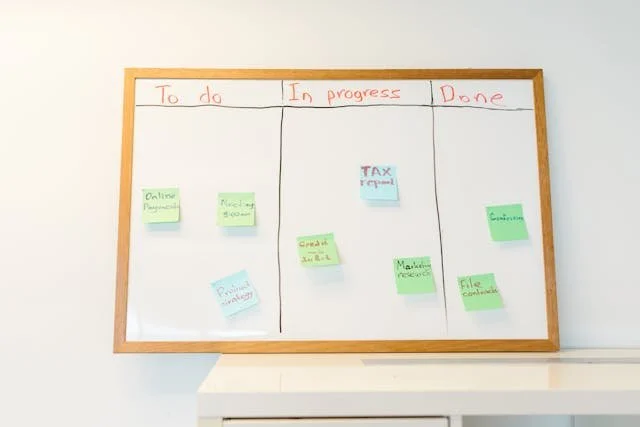
Photo by RDNE Stock project on Pexels
Make it easy - Reduce what Clear calls ‘the friction’ around getting cracking. Start with your to-do list. Break it down into smaller tasks. Then, when you have 5 minutes or 30 minutes, you can look at it and know exactly what to tackle first.
Make it attractive - Pair a tricky or tedious task with something you enjoy: a favourite drink or a playlist. Or head to a pleasant ‘out of office’ location, a café, a co-working space, or a sunny corner in your garden.
Make it satisfying - Give yourself fast feedback. Set up a simple streak tracker or scoreboard you can share with someone who’s cheering you on. Give yourself a tiny treat after that lead domino falls neatly into place. A daily ‘Done it’ list is an excellent antidote to an often overwhelming to-do list.
Meeting expectations according to your tendency and setting up helpful habit-forming systems are two top strategies for getting moving and motivated.
Enlisting the support of a select group of on-side humans is an excellent strategy for staying that way.
Build your support crew – Get different help from different folk

Photo by Pixabay on Pexels
Recruiting your career change cheer squad is a major motivation booster. It can also be a challenge to know how to ask for help and who to approach.
Often, the first step is facing down your fears about how friends, family and colleagues will react. Will they be sceptical, horrified, envious or just plain nonplussed?
When you drop the career change bomb shell, you’ll likely trigger some ‘shock horror’ responses, especially from close people who want you to be safe or think you’re bonkers for giving up what they see as a plum job.
Make tricky ‘I’ve decided to change my career’ conversations easier with these 8 Cool ways to tell family and friends you’re changing careers.
Armed with the above strategies for smoothing out these conversations, it’s time to recruit a range of humans to help you stay motivated and on track.
Tailor the size of your career change cheer squad to match your personality and needs. Extroverts may have a blockbuster cast of star supporters and extras. The more introverted amongst us (me included) may opt for a tiny team of trusted others.
The bottom line is to be specific. Recruit for some or all of these roles:
Emotional support - someone to help you stay buoyant and balanced when things get gnarly
Connection support – people who know people and are happy to connect you
Accountability support- someone to check you are getting done what you want to get done
Office support – someone who’ll review applications, help you perfect your portfolio or stage mock interviews
Skills support – someone who can mentor or guide you towards learning new skills or adapting current ones.
Get clear about the kinds of support you need. Then make gut-driven choices about who to ask for what.
Here are 7 Ways your career change cheer squad can support you.
Make it easy for people to say, ’Yes, I’d love to help,’ by being specific here too. For example, try something like, “I’d love to help me stay accountable for keeping my career change on track. Could we meet for a coffee to chat about the three things I’m planning to do each week? Or perhaps, ‘Would you be prepared to cast your eagle eye over my job applications and spend around 30 minutes helping me prepare for interviews?
Dealing with dips – Three tips from successful career changers
Despite our best efforts, motivation ebbs and flows. And there will almost certainly be moments in your career change marathon when your energy and focus will slip.
These observations from three of my resourceful, tenacious career change clients might help you endure, recalibrate or simply get out of your own way.
Be willing to sit with the discomfort for a while.

Career changer Gareth
‘You've got to carve out time to reflect and be honest with yourself about what's not working. And it's never too late to make a change if things aren't working. You just have to be willing to sit with the discomfort for a while.’
PR Professional Gareth applied this principle to help reset his career.

Career tweaker Astrid
Understand what change can look like.
‘I wish I had gone into the career change process with a broader understanding of what "change" can look like. It definitely doesn't have to be drastic to qualify as change. Small, intentional steps can lead to transformative outcomes over time.’
Urban Economist Astrid tweaked her career to better fit her values, lifestyle and desire to pursue her PhD.

Career changer Bec
Get out of your own head and back yourself.
‘I would often not apply for roles I was interested in because I didn't meet every single criterion. Once I overcame that, things started to happen!
I soon realised I already had a lot of the right skills and knowledge for the role I wanted. I just had to get out of my own head, back myself and think about applying those skills differently.’
Communications specialist Bec on reframing her skills to land a job she loves in Diversity and Inclusion.
Need help to get moving and motivated? Book a chat about your career change.
Hi, I’m Jo Green, a Career Change Coach.
I help thoughtful professionals who feel stuck or unfulfilled in their work find a clearer direction and move into work that feels meaningful and aligned with who they are.
Since 2016 I’ve supported hundreds of people to reshape their careers – whether that means changing roles, starting something new, or finding work that contributes more positively to people or the planet.
If you're thinking about a career change and want structured support, you can learn more about my career change coaching here.
Or you’re welcome to book a free 20-minute consultation to talk about where you’re at and whether coaching could help.